
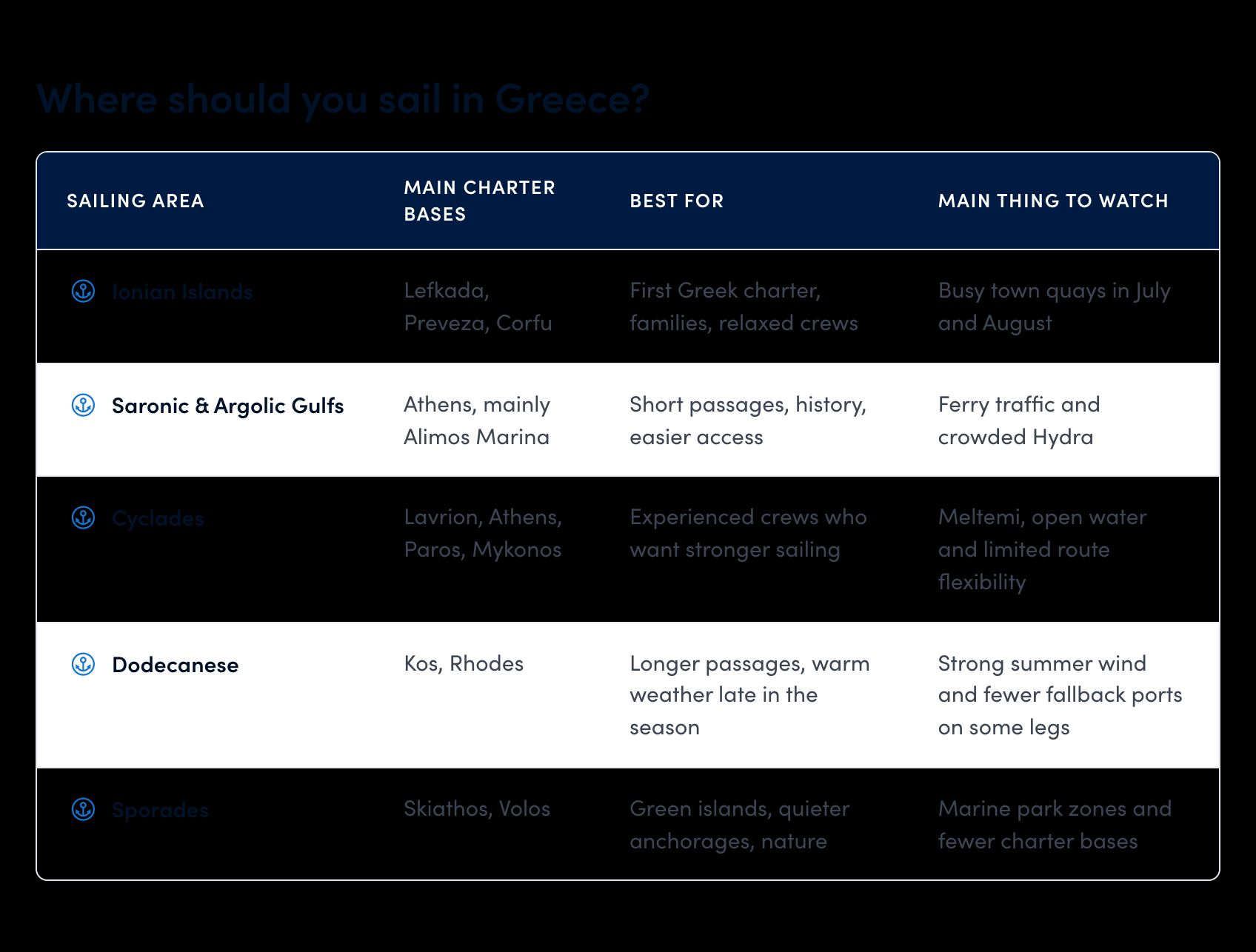
A week on a yacht in Greece can look very different depending on where you start. In the Ionian, you can expect shorter passages and generally calmer conditions. In the Cyclades, stronger winds and longer distances require more experience and a flexible plan. The Saronic Gulf, Dodecanese and Sporades each offer a different balance of sailing conditions, island towns, quiet anchorages and harbour availability.
Choosing the right sailing area is therefore more important than choosing individual islands. This guide compares the main charter regions in Greece and explains the weather, licence requirements, mooring costs in 2026 and practical routes for a one week sailing holiday.

Ionian Islands
The Ionian is the most forgiving area for a first bareboat week in Greece. From Lefkada, the usual route runs through Meganisi, Kalamos, Kastos, Ithaca and northern Kefalonia. Most legs are short, land is rarely far away and the afternoon northwesterly wind is usually more manageable than the Meltemi.

The tradeoff is popularity. Fiskardo, Kioni and the small harbours around Meganisi fill early in peak season. Keep one anchorage as a backup and do not build the route around getting a quay every night.
For a detailed plan, follow our seven day South Ionian sailing itinerary. You can also compare available boats and current yacht charter prices in Lefkada.
For the northern Ionian, Corfu gives easy access to Paxos, Antipaxos and the mainland bays around Sivota and Parga. See our seven day sailing itinerary from Corfu or browse boats available for charter in Corfu.
Saronic and Argolic Gulfs
The Saronic route is the practical choice if your crew is flying to Athens and wants easier conditions. Aegina, Poros, Epidaurus, Ermioni and Hydra fit into a comfortable week without long crossings.

Hydra is the exception to the relaxed rhythm. Its small harbour can become a stack of crossed anchors, rafted yachts and ferry wash. Unless you arrive early in calm weather, anchor in a nearby bay and visit town by water taxi.
Our seven day Saronic Islands itinerary starts in Athens and includes Aegina, Hydra, Dokos, Poros and Epidaurus. You can compare available yachts and current charter prices in Marina Alimos.
Cyclades
The Cyclades have the strongest sailing in Greece and the least room for a fixed schedule. In July and August, the Meltemi can blow for several days, especially around Kea, Kythnos, Mykonos, Paros and Naxos. A rigid route is a bad plan here.

For one week, start in Lavrion and keep the route compact. Kea, Kythnos, Syros and Serifos are already enough. Trying to add both Mykonos and Santorini creates long legs and little margin for weather. Athens to Santorini is about 130 nautical miles, roughly 20 hours underway at typical charter speeds.
Experienced crews looking for a more ambitious route can read our Cyclades sailing itinerary from Athens. For a more flexible starting point, compare available boats and current yacht charter prices in Lavrion.
Dodecanese
The Dodecanese suit crews who want longer open-water passages, reliable summer wind and fewer crowded charter routes than in the Cyclades. From Kos, a practical route can include Kalymnos, Leros, Lipsi and Patmos. From Rhodes, Symi and Tilos are natural choices.
The Turkish coast is close, but crossing the border requires formal clearance and may not be permitted under your charter agreement. Confirm the procedure with the charter company before departure. Do not treat Turkey as a casual lunch stop.

For more route inspiration, see our six day Dodecanese sailing itinerary from Kos. You can compare available boats and current yacht charter prices in Kos.
Sporades
The Sporades offer a different landscape, with pine covered Skopelos and the protected waters around Alonissos. They suit crews who want quieter islands and do not mind a smaller choice of charter boats. Check the current marine park zones before anchoring or approaching the more strictly protected islands.

Our seven day Sporades sailing itinerary starts in Volos and continues through Skiathos, Skopelos and Alonissos. To compare rental options and current prices, browse sailing yachts in Volos or boats available in Skiathos.
The best time to sail in Greece
For most crews, the best weeks are in June and from early to mid September. The weather is warm, the sea is comfortable and the busiest harbours are less congested than in August.
May and June
In May, harbours are quiet and prices lower, but the sea is cooler and passing weather fronts are still possible. June has the best overall balance. Days are long, temperatures are manageable and the peak Meltemi period has usually not arrived.
July and August
These are the warmest and busiest months. The Meltemi is strongest in the Aegean. Less experienced crews should favour the Ionian or the Saronic Gulf.
September and October
In September the sea stays warm and fewer boats compete for the quays. Early September can still have strong Meltemi days, while later in the month the chance of unsettled weather gradually rises. October is still suitable for sailing, especially in the Dodecanese and southern Ionian, but daylight is shorter and autumn fronts can change conditions quickly.
Our choice for a normal one week charter is mid June. If warm water matters more than long daylight, choose the first half of September.
The Meltemi
The Meltemi is a dry northerly wind that shapes summer sailing in the Aegean. It is most frequent in July and August and is usually strongest during the day. It can also continue through the night and last for several days.

Acceleration zones between islands and around headlands matter more than the headline wind speed. A forecast of Force 5 can feel very different in a narrow channel or below a steep coast.
Check the official Hellenic National Meteorological Service marine forecast, compare it with a second model and ask the charter base about local acceleration zones. In the Cyclades, keep at least one day of the route unassigned. If the forecast changes, change the plan early.
Which sailing licence do you need in Greece?
Bareboat charter requirements
For a bareboat charter, the skipper must hold a sailing qualification accepted by the charter company and the relevant Greek port authority. Commonly accepted documents include an ICC, suitable RYA qualifications and equivalent national certificates, but acceptance depends on the exact certificate, issuing country, yacht and charter base.
Send a copy of your licence to Boataround before booking or paying the final balance. Bring the original document to check-in. If radio competence is not included, ask whether a separate VHF or SRC certificate is required.
The contract normally names a second adult with sailing experience as co-skipper, and the charter company may ask them to sign a declaration of competence. They do not usually need a second formal licence.
Skippered charter
If nobody in the crew meets the requirements, book a professional skipper. Guests on a skippered charter do not need their own sailing licence.
Mooring in Greece and what it costs in 2026
Mediterranean mooring at town quays
Most public town quays use Mediterranean mooring. You drop the bow anchor and reverse towards the quay. Laid mooring lines are less common than in Croatia, so the yacht's anchor and windlass do real work throughout the week.
Med Mooring Guide
During check in, test the windlass, inspect the anchor and confirm the chain markings. Carry two long stern lines and at least one separate shore line. In small coves, a stern line to a fixed ring or suitable rock can reduce swinging. Avoid trees and never run a line where it blocks another boat or a dinghy route.

Catamarans cost more because of their beam. A surcharge of 50 percent is common, but some marinas charge double.
Alimos Marina price example
One useful 2026 benchmark is Alimos Marina in Athens. Its official tariff lists a transit berth for a monohull up to 12.99 metres at €42 per day and a catamaran of the same length at €84. VAT and some services are extra. Private marinas such as Gouvia or Lefkas can cost much more, especially in July and August.
Keep some cash on board. Small harbours may collect the fee at the boat, while water and electricity can use separate cards, tokens or local providers.
Anchoring rules and protected areas
Anchoring in ordinary bays
You can usually anchor free in ordinary Greek bays, but not everywhere. Swimming zones, ferry approaches, archaeological sites and marine parks can have local restrictions. Check the chart, harbour notices and signs rather than assuming that an empty bay is unrestricted.
Greek law protects Posidonia seagrass, and an anchor can cut through a meadow in seconds. Use a clear sand patch, check the seabed before dropping and make sure the chain will also remain over sand as the boat swings. This improves holding and avoids damage.
Always show an anchor light at night. In gusty bays, set an anchor alarm and leave enough distance from the shore for a wind shift.
Marine parks and protected zones
Extra rules apply in the National Marine Park of Zakynthos and the National Marine Park of Alonissos and Northern Sporades. Some zones limit access, speed, fishing, overnight stays or anchoring. Follow the current park map and use designated moorings where provided.
Practical one week routes
Choose a route that still works after you lose one day to weather.
Best first Greek charter. Lefkada, Meganisi, Kastos, Kalamos, Ithaca, Kefalonia, Lefkada. Short legs, many fallback anchorages and manageable summer wind. See our detailed South Ionian sailing itinerary.
Best route from Athens. Alimos, Aegina, Hydra or Ermioni, Dokos, Poros, Epidaurus, Alimos. This combines island towns, quiet anchorages and ancient sites without forcing long passages. See the full Saronic Islands itinerary.
Best route for stronger sailing. Lavrion, Kea, Kythnos, Syros, Serifos, Lavrion. Keep one flexible day and shorten the loop if the Meltemi strengthens. Do not make Santorini a compulsory target on a standard one week charter.
Best quieter alternative. Skiathos, Skopelos, Alonissos, Peristera, Skopelos, Skiathos. Green islands and good swimming, with marine park rules to check before departure. See our seven day Sporades itinerary.
Our recommendation
For a first bareboat charter in Greece, choose Lefkada in June or the first half of September. You get short passages, several protected alternatives and enough wind to sail without building the entire holiday around the Meltemi.
If flight access through Athens matters more, choose the Saronic Gulf. Pick the Cyclades only when the skipper is comfortable reefing early, mooring in crosswinds and dropping a planned island without turning it into a debate.
Browse available sailing yachts and catamarans in Greece, then ask the charter partner to confirm the licence requirements for your crew before you pay the final balance.